RU
RU  ES
ES  FR
FR  EN
EN  IT
IT 

Planning to spend three days in Naples? That's enough time to discover the city's most iconic landmarks, explore its historic streets, admire breathtaking views of the Bay of Naples and, of course, enjoy some of the best food in Italy.
Naples is a city best experienced on foot. Around every corner you'll find centuries of history, vibrant neighborhoods, impressive churches, lively squares and small family-run businesses that have shaped the city's character for generations.
Three days won't allow you to see everything, but they are enough to experience the authentic atmosphere that makes Naples unlike any other destination in Italy.
This itinerary has been designed for first-time visitors who want to combine history, culture, local traditions, spectacular viewpoints and unforgettable food without rushing from one attraction to another.
Only have two days in Naples? We have also created a 2-day Naples itinerary, designed to cover some of the city's highlights without turning your stay into a race from one attraction to the next.
Hotel Il Convento, located in the heart of the Spanish Quarter, is an excellent starting point for exploring the city. Many of Naples' main attractions are within walking distance, while the metro and the historic funicular railways make reaching other areas quick and easy.
Useful Information
- Best time to visit: Naples is enjoyable year-round, although spring and autumn usually offer the most pleasant weather.
- Getting around: Mostly on foot, with occasional use of the metro, funiculars and public buses.
- Difficulty: Easy. Expect to walk approximately 4–5 km (2.5–3 miles) each day.
- Suitable for: Couples, families, solo travellers and small groups.
- Recommended starting point: The Spanish Quarter (Quartieri Spagnoli).
- Advance booking: some attractions, particularly the Sansevero Chapel and Mount Vesuvius, should be organised before your trip. See our guide to what to book in advance in Naples to find out which tickets you should buy ahead and which visits can wait until you arrive.
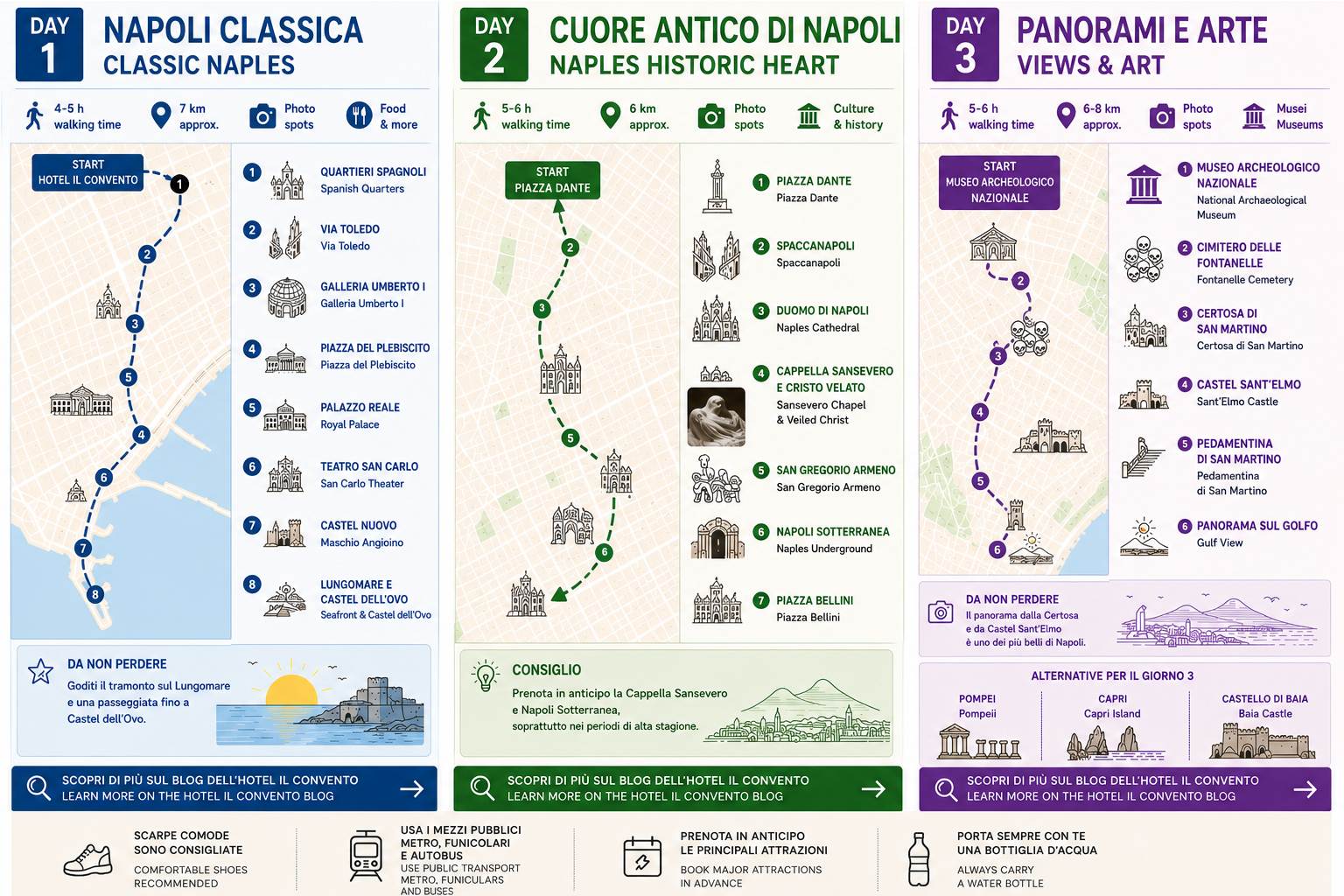
Your 3-Day Naples Itinerary at a Glance
Day One
- Spanish Quarter
- Maradona Mural
- Via Toledo
- Galleria Umberto I
- Teatro di San Carlo
- Piazza del Plebiscito
- Royal Palace
- Castel Nuovo (Maschio Angioino)
- Seafront Promenade and Castel dell'Ovo at sunset
Day One: Discover Naples' Historic Heart
Your first day is dedicated to the city's most famous landmarks and elegant streets, all located within easy walking distance of one another.
Start your morning in the Spanish Quarter (Quartieri Spagnoli), one of Naples' most authentic and fascinating neighborhoods. Originally built in the 16th century to house Spanish soldiers, today it has become one of the city's most vibrant districts, where local life and tourism naturally blend together.
Walking through its narrow streets you'll discover colorful balconies, traditional shrines, artisan workshops, family-owned restaurants and countless scenes of everyday Neapolitan life.
One of the neighborhood's highlights is undoubtedly the famous Maradona Mural, a place that has become almost a pilgrimage site for football fans from around the world. Even visitors who know little about football quickly understand how deeply Diego Maradona remains connected to the identity of Naples.
If you'd like to learn more about the Spanish Quarter and the Maradona Mural, you'll find dedicated articles on our blog.
From here it's just a short walk to Via Toledo, Naples' main shopping street and one of the liveliest avenues in the city.
Along the way, take time to admire the magnificent Galleria Umberto I, a beautiful 19th-century shopping gallery covered by an impressive glass dome, and the historic Teatro di San Carlo, the oldest continuously operating opera house in the world.
A few minutes later you'll arrive at Piazza del Plebiscito, Naples' largest and most elegant square, surrounded by the Royal Palace and the impressive Basilica of San Francesco di Paola.
If time allows, visit the Royal Palace, once home to the Bourbon kings, before continuing towards Castel Nuovo, better known locally as Maschio Angioino.
End your first day with a relaxing walk along the beautiful Lungomare Caracciolo. As the sun begins to set, the views over the Bay of Naples, Mount Vesuvius and Castel dell'Ovo become truly unforgettable.
For dinner, this is the perfect opportunity to experience authentic Neapolitan pizza. If you've already tried the traditional classics, you may also want to discover Naples' growing gourmet pizza scene, where local tradition meets contemporary creativity.
Day Two
- Piazza Dante
- Spaccanapoli
- Sansevero Chapel
- The Veiled Christ
- Naples Cathedral
- San Gregorio Armeno
- Naples Underground
- Piazza Bellini
Day Two: Explore Naples' UNESCO Historic Centre
Your second day takes you into the oldest part of Naples, a UNESCO World Heritage Site and one of the largest historic city centres in Europe. Here, more than 2,500 years of history unfold through narrow streets, magnificent churches, hidden courtyards and lively piazzas.
From Hotel Il Convento you can either enjoy a pleasant walk along Via Toledo or take Metro Line 1 to Piazza Dante, the ideal gateway to Naples' historic centre.
From Piazza Dante, continue along the famous Spaccanapoli, the long, narrow street that appears to split the historic centre in two. In reality, it follows the route of one of the ancient Greek roads that shaped the original city over two thousand years ago.
Walking along Spaccanapoli is one of the best ways to experience Naples. Historic churches stand beside artisan workshops, cafés overflow onto the streets, and everyday Neapolitan life unfolds around every corner.
Visit the Sansevero Chapel and the Veiled Christ
Your first major stop should be the Sansevero Chapel, home to one of Italy's greatest artistic masterpieces: the extraordinary Veiled Christ.
Created in 1753 by sculptor Giuseppe Sanmartino, the marble veil covering Christ's body is carved with such astonishing realism that, for centuries, visitors believed it had been transformed from real fabric into stone through alchemy.
Today, the Veiled Christ is considered one of the finest marble sculptures ever created.
Tickets frequently sell out well in advance, especially during spring and summer, so booking online before your trip is highly recommended.
Naples Cathedral and the Treasure of San Gennaro
Continue towards Naples Cathedral (Duomo di Napoli), dedicated to the city's patron saint, San Gennaro.
The cathedral is famous worldwide for the Miracle of San Gennaro, a centuries-old religious tradition during which the saint's dried blood is believed to liquefy on specific dates each year. Thousands of pilgrims and visitors gather to witness this remarkable event.
Even if you're not interested in religious history, the cathedral is worth visiting for its impressive architecture and the beautiful early Christian Basilica of Santa Restituta, located inside the complex.
San Gregorio Armeno: Christmas All Year Round
Just a few minutes away lies San Gregorio Armeno, perhaps Naples' most famous street.
Often referred to as "Christmas Alley," this charming lane is lined with workshops where skilled artisans handcraft traditional nativity figurines throughout the year.
Alongside biblical characters, you'll also find miniature versions of football players, movie stars, politicians and celebrities, reflecting current events with the unmistakable humour of Neapolitan craftsmanship.
Even outside the Christmas season, San Gregorio Armeno remains one of the city's most fascinating places to explore.
While exploring the historic centre, stop at a pastry shop to discover a local speciality. Alongside sfogliatella, try Neapolitan pastiera, the traditional Easter cake surrounded by fascinating legends.
Discover Naples Underground
No visit to Naples would be complete without exploring what lies beneath the streets.
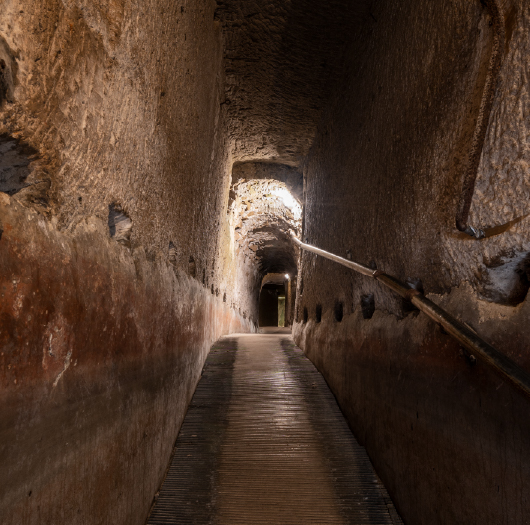
Naples Underground (Napoli Sotterranea) offers guided tours through ancient Greek aqueducts, Roman tunnels and Second World War air-raid shelters, revealing a hidden city that few visitors expect to find.
The experience provides a completely different perspective on Naples, showing how thousands of years of history have literally been built on top of one another.
Individual visitors generally don't need to book far in advance if they're happy to join a tour in Italian or English. If you have specific language requirements or are visiting during a particularly busy period, it's worth checking the available tours before your visit.
Relax in Piazza Bellini
End your day in Piazza Bellini, one of Naples' favourite meeting places.
Surrounded by cafés, wine bars and bookstores, it's particularly popular with students, artists and locals. It's the perfect place to enjoy an aperitivo, have dinner or simply sit outside and soak up the atmosphere.
By the end of your second day, you'll have experienced a completely different side of Naples: not the grand boulevards and monumental squares of the previous day, but the city's ancient soul, where history, traditions and everyday life come together in an unforgettable way.
Day Three
- Option A: National Archaeological Museum, Fontanelle Cemetery, Certosa di San Martino, Castel Sant'Elmo and the Pedamentina Stairway.
- Option B: A full-day trip to Pompeii.
- Option C: A day trip to Capri.
Day Three: Choose Your Perfect Experience
After discovering Naples' elegant waterfront and its historic centre, your final day can be tailored to your interests.
If you love museums and panoramic views, stay in the city and explore some of its most spectacular landmarks. If you'd rather discover the surrounding region, dedicate the day to one of Campania's world-famous destinations.
Option A: Panoramic Naples
Begin your morning at the National Archaeological Museum of Naples, home to one of the world's most important collections of Roman antiquities. Many of the masterpieces discovered in Pompeii and Herculaneum are preserved here, making it an essential stop for anyone interested in the history of ancient Rome.
Continue to the Fontanelle Cemetery, located in the historic Rione Sanità district. Far more than a cemetery, this remarkable site tells the story of Naples' unique relationship with popular traditions, faith and local folklore.
In the afternoon, take one of Naples' historic funicular railways up to the Vomero Hill district. Within just a few minutes you'll reach the magnificent Certosa di San Martino and Castel Sant'Elmo, where you'll enjoy one of the finest panoramic views over Naples, Mount Vesuvius and the Bay.
Instead of taking the funicular back down, consider walking along the historic Pedamentina Stairway, an ancient staircase of more than 400 steps connecting the hilltop with the historic centre. It's one of the city's most scenic and rewarding walks.
If you'd like to learn more, our blog includes dedicated articles about Naples' historic funiculars and the beautiful Pedamentina walking route.
Option B: Discover Pompeii
No first visit to Naples is truly complete without seeing Pompeii.
The archaeological site can easily be reached by train from Naples and offers one of the most extraordinary archaeological experiences anywhere in the world.
Walking through its remarkably preserved streets, houses, temples and theatres allows visitors to experience daily life exactly as it was before Mount Vesuvius erupted in AD 79.
Plan to spend most of the day here, as Pompeii deserves several hours of exploration.
Option C: Spend the Day on Capri
If you're looking for spectacular coastal scenery, choose a day trip to Capri.
Hydrofoils and ferries depart regularly from Molo Beverello, which can easily be reached on foot from Hotel Il Convento.
Once on the island, spend the day exploring the famous Piazzetta, the Gardens of Augustus, Marina Grande or, weather permitting, the spectacular Blue Grotto.
Our blog also includes a practical guide explaining how to make the most of one day in Capri.
What to Eat During Your Stay
No trip to Naples would be complete without discovering its incredible food culture.
During your three days, make sure you try at least some of the city's most iconic dishes:
- Traditional Neapolitan Pizza.
- Gourmet Pizza, one of Naples' newest culinary trends.
- Riccia and Frolla Sfogliatella pastries.
- Cuoppo, the famous cone of freshly fried seafood.
- Neapolitan Ragù.
- Pasta alla Genovese.
- Fiocco di Neve, one of Naples' most beloved desserts.
Our blog features dedicated guides to traditional Neapolitan pizza, gourmet pizza and where to enjoy the city's famous sfogliatella.
Getting Around Naples
One of the great advantages of Naples is that many of its main attractions are surprisingly close to one another.
Most of this itinerary can comfortably be completed on foot. For longer distances, Metro Line 1 and Metro Line 2 and the city's historic funicular railways provide fast and convenient connections.
If you're planning to use public transport several times during your stay, choosing the right ticket can also save you money. Our guide to Naples public transport tickets explains current prices, single tickets, day and weekly passes, integrated tickets and the options for travelling to Pompeii, Sorrento and the Amalfi Coast.
Taxis are widely available and may be useful when travelling with luggage or returning late in the evening, although public transport is generally the more economical choice.
Useful Travel Tips
- Book ahead for the attractions that really require it. Our guide to what to book in advance in Naples explains which visits are worth organising before you travel.
- Wear comfortable walking shoes — you'll spend much of your time exploring on foot.
- Carry a refillable water bottle, especially during the warmer months.
- Leave time for spontaneous discoveries. Some of Naples' greatest treasures are found by simply wandering through its streets.
- Don't try to see everything. Naples rewards slow travel far more than rushing from one attraction to another.
Three Days in Naples... and You'll Want to Return
Three days are enough to discover why Naples fascinates millions of visitors every year.
You'll experience magnificent architecture, fascinating history, unforgettable views, extraordinary food and one of Europe's most vibrant urban cultures.
Yet you'll probably leave with the feeling that you've only scratched the surface.
That's perhaps Naples' greatest charm: every visit reveals something new, making it a city people return to again and again.
If you're planning to stay longer or explore beyond the city, you'll find many more itineraries, travel guides and local tips throughout our blog.
Frequently Asked Questions
Is three days enough to visit Naples?
Yes. Three days are enough to explore the city's main attractions while still enjoying its atmosphere, food and local culture at a relaxed pace.
Can I explore Naples without a car?
Absolutely. Most of the historic centre is best explored on foot, while the metro, funiculars and trains make it easy to reach other districts and nearby destinations.
When is the best time to visit Naples?
Spring and autumn usually offer the most comfortable weather, although Naples is a year-round destination thanks to its mild Mediterranean climate.
Which day trip should I choose?
If it's your first visit, Pompeii is an unforgettable experience. Capri is perfect for those looking for spectacular coastal scenery, while the Campi Flegrei area offers a fascinating alternative for travellers interested in archaeology and lesser-known destinations.