RU
RU  ES
ES  FR
FR  EN
EN  IT
IT 

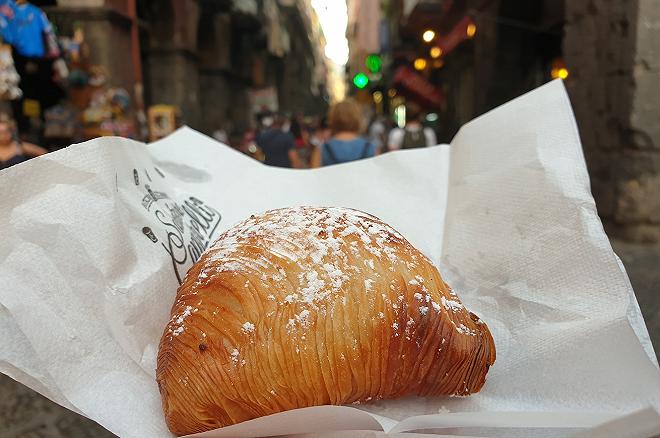
Ask a visitor what food they associate with Naples and the answer is almost always pizza.
Ask a Neapolitan which pastry best represents the city and the answer is immediate: sfogliatella.
Crisp, fragrant and filled with sweet ricotta and semolina, this iconic pastry has become one of the symbols of Naples. Whether enjoyed first thing in the morning with an espresso, during an afternoon stroll through the historic centre or as a quick break between sightseeing stops, tasting a freshly baked sfogliatella is an experience that every visitor should have at least once.
The difficult part isn't finding one.
The difficult part is deciding where to stop.
Fortunately, if you're staying at Hotel Il Convento, you're already within walking distance of several of Naples' most historic pastry shops. Via Toledo, the Spanish Quarter and the historic centre offer some of the city's best places to discover this beloved dessert without needing public transport.
| Sfogliatella at a Glance | |
|---|---|
| Origin | Naples (recipe originally developed on the Amalfi Coast) |
| Main Ingredients | Ricotta, semolina, candied citrus and sugar |
| Traditional Versions | Riccia and Frolla |
| Best Time to Eat | Freshly baked, still warm |
| Perfect Pairing | Espresso coffee |
What Is a Sfogliatella?
Sfogliatella is one of Italy's most distinctive pastries.
Although its filling remains largely the same—ricotta, semolina, sugar and candied citrus—the outer pastry changes completely depending on the version you choose.
For locals, choosing between the two is almost a matter of personal identity.
For visitors, it's simply an excellent excuse to order both.
Riccia or Frolla? What's the Difference?
Every visitor eventually faces the same question.
Should I order the riccia or the frolla?
The truth is that there isn't a correct answer.
Each version offers a completely different experience while preserving the same traditional filling.
Sfogliatella Riccia
The riccia is the version most people recognise immediately.
Its shell consists of dozens of incredibly thin layers of pastry wrapped around the filling to create the famous shell-like shape.
Fresh from the oven, every bite produces the unmistakable crisp sound that Neapolitans associate with a perfectly baked sfogliatella.
The contrast between the crunchy exterior and the soft filling is what has made this version famous all over the world.
Sfogliatella Frolla
The frolla couldn't be more different.
Instead of delicate layers, it uses a rich shortcrust pastry that is soft, buttery and slightly crumbly.
The filling remains almost identical, but the texture changes completely.
Many visitors arrive convinced they'll prefer the riccia, only to discover that the frolla becomes their favourite.
Among local pastry chefs, preparing an outstanding frolla is often considered the real test of skill. Since shortcrust pastry leaves no room for mistakes, its quality immediately reveals the craftsmanship behind the bakery.
Our advice is simple.
Don't choose.
Order one of each.
A Pastry with Monastic Origins
Like many of Italy's most famous traditional recipes, the story of the sfogliatella begins in a monastery.
According to tradition, the earliest version of the pastry was created during the eighteenth century in the Monastery of Santa Rosa, overlooking the Amalfi Coast.
The nuns were looking for a way to avoid wasting leftover ingredients from the convent kitchen. By combining semolina cooked in milk with fresh ricotta, sugar and dried fruit, they created a rich filling unlike anything that existed at the time.
Wrapped inside a delicate pastry shell and baked until golden, the recipe soon became famous beyond the monastery walls.
Years later, Neapolitan pastry chefs adapted and refined the original preparation, eventually creating the sfogliatella we know today.
Although several variations have appeared over the centuries, the traditional recipe remains one of the great symbols of Neapolitan pastry.
Where to Eat the Best Sfogliatella in Naples
This is probably one of the questions that sparks the liveliest debates among Neapolitans.
Ask ten locals where to find the city's best sfogliatella and you'll almost certainly receive ten different answers.
The truth is that Naples is home to many outstanding pastry shops, each with loyal customers who wouldn't dream of going anywhere else.
If it's your first visit, these historic names are an excellent place to start.
Pintauro
For many people, Pintauro is where the modern story of the sfogliatella begins.
Located on Via Toledo, just a few minutes' walk from Hotel Il Convento, this historic pastry shop has been serving freshly baked sfogliatelle for generations.
Its riccia remains one of the city's most famous versions, often enjoyed standing outside the shop while it's still warm from the oven.
If you're exploring Via Toledo or the Spanish Quarter, stopping here feels almost inevitable.
Scaturchio
Situated in the beautiful Piazza San Domenico Maggiore, Scaturchio is one of Naples' most historic pastry shops.
Although internationally known for its famous Ministeriale chocolate, its sfogliatelle continue to attract both locals and visitors every day.
Its location also makes it an excellent stop while exploring the historic centre.
Attanasio
If you arrive in Naples by train, chances are you'll notice the queue before you even see the shop.
Attanasio, just a short walk from Napoli Centrale station, has become something of a legend.
Its reputation has spread well beyond Italy, thanks in part to countless travel documentaries and social media posts.
Long queues are common, but many visitors consider the wait part of the experience.
Fresh Is Everything
One simple rule applies wherever you decide to stop.
Eat your sfogliatella as soon as it's served.
The riccia reaches its peak when the outer layers are still crisp and the filling is pleasantly warm. Wait too long, and part of the magic disappears.
The same applies to the frolla. Fresh from the oven, its buttery pastry is wonderfully soft while the filling remains light and fragrant.
Pair it with a traditional Neapolitan espresso and you'll understand why this simple combination has remained a daily ritual for generations.
The Curious Story Behind Its Name
Most visitors know the pastry simply as sfogliatella.
Few realise that its original name was actually sfogliata.
Interestingly, in the Neapolitan dialect the word sfogliatella did not originally refer to food at all. It described something troublesome or difficult to deal with—an unexpected burden that refused to go away.
Over time, however, the diminutive form gradually became associated with the pastry itself, eventually replacing the original name almost completely.
Language, much like recipes, evolves naturally. Today, almost everyone refers to Naples' most famous pastry simply as the sfogliatella.
More Than One Sfogliatella
One of the pleasures of spending several days in Naples is discovering that there isn't just one perfect sfogliatella.
Every historic pastry shop has its own interpretation. Some focus on an exceptionally crisp riccia, while others are celebrated for a delicate and perfectly balanced frolla. Even the filling varies slightly from one bakery to another, with subtle differences in sweetness, citrus aroma and texture.
Rather than searching for the single "best" sfogliatella, consider tasting several during your stay.
You may be surprised to discover that your favourite is not necessarily the one everyone recommends.
A Sweet Stop During Your Walk Around Naples
One of the advantages of staying in the area around Via Toledo and the Spanish Quarter is that many of Naples' most famous pastry shops are within easy walking distance.
A typical morning could begin with breakfast near the hotel, continue with a stroll along Via Toledo, a visit to the historic centre and Piazza San Domenico Maggiore, and include more than one opportunity to stop for a freshly baked sfogliatella.
Unlike many famous desserts, the sfogliatella isn't reserved for special occasions.
For Neapolitans, it's simply part of everyday life.
Practical Tips
- Try both the riccia and the frolla before deciding which one you prefer.
- Eat your sfogliatella while it's still warm for the best flavour and texture.
- Pair it with a traditional Neapolitan espresso.
- Don't judge a pastry shop after tasting only one version—many excel at one style more than the other.
- If you have several days in Naples, visit different historic bakeries rather than returning to the same one every time.
Frequently Asked Questions
What is the difference between riccia and frolla?
The riccia has a crisp shell made of dozens of thin pastry layers, while the frolla is prepared with soft shortcrust pastry. Both contain a traditional filling of ricotta, semolina, sugar and candied citrus.
Where can I eat the best sfogliatella in Naples?
Historic pastry shops such as Pintauro, Scaturchio and Attanasio are among the city's best-known names, but many smaller neighbourhood bakeries also produce excellent sfogliatelle.
When should you eat a sfogliatella?
There is no fixed time. Many locals enjoy one for breakfast with coffee, while others choose it as an afternoon treat or dessert.
Is sfogliatella only found in Naples?
You can find it in many Italian cities today, but Naples remains its true home and the best place to experience it freshly baked.
A Pastry That Tells the Story of Naples
Some cities are remembered through monuments.
Others through flavours.
In Naples, the aroma of a freshly baked sfogliatella drifting out of a historic pastry shop is as much a part of the city's identity as its churches, castles and breathtaking views across the Bay.
Whether you prefer the crisp layers of the riccia or the buttery softness of the frolla, one thing is almost certain: after your first bite, you'll understand why generations of Neapolitans remain so passionate about this remarkable pastry.
And don't be surprised if, before leaving the city, you find yourself stopping for "just one more."