RU
RU  ES
ES  FR
FR  EN
EN  IT
IT 

Many first-time visitors imagine Naples as a city that stretches along the waterfront.
Only after arriving do they discover something completely different: Naples is also a vertical city.
Historic neighbourhoods climb steep hillsides, spectacular viewpoints overlook the Bay of Naples and some of the city's most beautiful attractions—including Castel Sant'Elmo and the Certosa di San Martino—are located hundreds of metres above sea level.
Fortunately, reaching them is much easier than it looks.
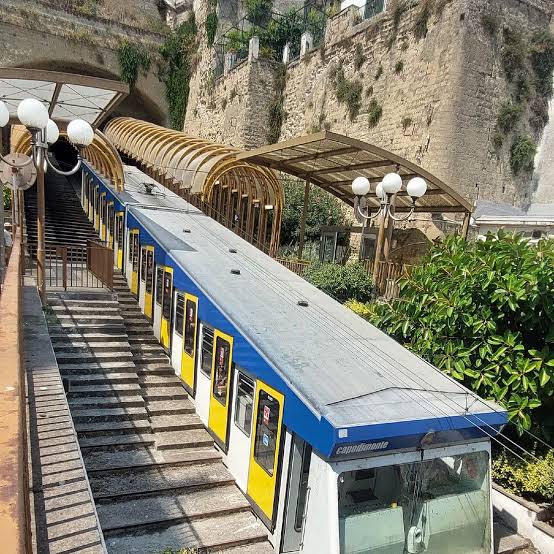
Naples has one of Europe's oldest and most efficient urban funicular systems, allowing both residents and visitors to travel from the city centre to the hills in just a few minutes.
If you're staying around Via Toledo or the Spanish Quarter, several funicular stations are within easy walking distance, making them one of the simplest ways to explore parts of Naples that many visitors would otherwise miss.
| Naples Funiculars at a Glance | |
|---|---|
| Number of Lines | 4 |
| Main Destinations | Vomero, Posillipo and Chiaia |
| Journey Time | 3–7 minutes |
| Tickets | Standard ANM public transport tickets |
| Best For | Castel Sant'Elmo, San Martino, panoramic views |
Which funicular should you take to Vomero? If you're starting from Via Toledo or the Spanish Quarter, the Central Funicular (Funicolare Centrale) is generally the most convenient option, running from Piazza Augusteo to Piazza Fuga in Vomero. If you're closer to the Pignasecca or Montesanto area, the Montesanto Funicular is usually the better choice.
Why Use the Funiculars?
The obvious answer is simple.
They save you from climbing some very steep hills.
But there is another reason why visitors quickly fall in love with Naples' funiculars.
They allow you to experience two completely different sides of the city in the same day.
You can spend the morning wandering through the lively streets of the Spanish Quarter, reach the elegant district of Vomero in just a few minutes, admire one of the most breathtaking panoramas in Italy from Castel Sant'Elmo, then return to the historic centre without ever feeling exhausted.
It's one of the easiest ways to understand how dramatically Naples changes from one neighbourhood to another.
How Much Does the Naples Funicular Cost?
The funiculars are part of Naples' public transport network, operated by ANM.
This means you don't need a special ticket.
The same ticket used for buses, metro lines and other public transport can also be used on the funiculars.
Tickets are available from station vending machines, authorised tobacco shops, newsagents and through official mobile ticketing apps.
Because fares occasionally change, it's always worth checking the latest prices before travelling.
For most visitors, the integrated ticket offers the best value, allowing you to combine metro, buses and funiculars during the same journey.
To compare single tickets, day passes, weekly passes and integrated fares, read our guide to Naples public transport tickets, with current prices and practical advice on choosing the right ticket.
The Four Funicular Lines
Although all four funiculars operate on the same principle, each serves a different part of the city.
Depending on your itinerary, one line may be considerably more useful than the others.
Central Funicular (Funicolare Centrale)
This is the line that most visitors use.
It connects Piazza Augusteo, just off Via Toledo, with Piazza Fuga, in the heart of the Vomero district.
If your goal is to visit Castel Sant'Elmo, the Certosa di San Martino or the elegant shopping streets around Via Scarlatti, this is almost certainly the easiest option.
The journey lasts only a few minutes.
Some services run direct, while others make intermediate stops at Petraio and Corso Vittorio Emanuele. Electronic displays inside the station clearly indicate which service is departing next, making the system very easy to understand even if it's your first visit to Naples.
Montesanto Funicular (Funicolare di Montesanto)
The Montesanto Funicular is often overlooked by first-time visitors, yet it serves one of the most rewarding itineraries in Naples.
Starting from the lively Montesanto district, close to the famous Pignasecca Market, it climbs to Via Morghen in the heart of Vomero.
This is the ideal line if you plan to visit the Belvedere di San Martino or walk down the spectacular Pedamentina di San Martino, one of Naples' oldest stairways connecting the hill with the historic centre.
In just a few minutes, you'll move from one of the city's busiest traditional neighbourhoods to one of its quietest panoramic areas.
Chiaia Funicular (Funicolare di Chiaia)
The Chiaia Funicular links the elegant Chiaia district with Vomero.
It first opened in 1889 and is the oldest funicular railway in Naples.
This route is particularly useful if you're spending time along the seafront, exploring Via dei Mille or shopping in Chiaia before heading uphill to Piazza Vanvitelli and Via Scarlatti.
Although less used by tourists than the Central Funicular, it offers another convenient way to explore the city without tackling steep streets on foot.
Mergellina Funicular (Funicolare di Mergellina)
The least-known of Naples' four funiculars connects Mergellina with the Posillipo hill.
Few visitors use it, which is a pity.
Posillipo is home to some of the city's most spectacular viewpoints, elegant residential streets and peaceful parks overlooking the Bay of Naples.
If you've already visited the historic centre and want to discover a quieter side of the city, this line is well worth considering.
The Best Itinerary Using the Funiculars
If you only have one or two days in Naples, the funiculars make it easy to create an itinerary that combines history, panoramic views and local neighbourhoods without spending hours walking uphill.
A route we often recommend begins around Via Toledo, continues with the Central Funicular to Vomero, includes a visit to Castel Sant'Elmo and the Certosa di San Martino, then follows the beautiful Pedamentina di San Martino downhill to Montesanto before returning through the historic centre.
It offers an entirely different perspective of Naples—one that many visitors never experience.
A City Transformed by the Funiculars
Today, it's difficult to imagine Naples without its funicular railways.
When they were built at the end of the nineteenth century, however, they completely changed the city's development.
Before their construction, the Vomero hill was largely rural and sparsely populated.
Travelling between the city centre and the hill required long climbs on foot or by horse-drawn carriage.
The arrival of mechanical transport transformed the area almost overnight.
Elegant apartment buildings, schools, theatres and cafés quickly appeared, turning Vomero into one of Naples' most desirable residential districts.
In many ways, the funiculars didn't simply connect different neighbourhoods.
They reshaped the city itself.
Tips for Using the Naples Funiculars
Although the system is easy to use, a few simple tips can make your journey even smoother.
- Travel outside rush hour if possible. Early mornings and late afternoons are when local commuters use the funiculars the most.
- Keep your ticket with you until the end of your journey, as it may be checked during or after your trip.
- If you're planning to visit several attractions in one day, consider purchasing an integrated public transport ticket rather than single rides.
- Don't be afraid to use the funiculars more than once. They're designed for everyday travel and are one of the fastest ways to move around the city.
- Whenever possible, plan your visit to Vomero in the late afternoon. Watching the sun set over the Bay of Naples from Castel Sant'Elmo is one of the city's unforgettable experiences.
Common Mistakes Visitors Make
Many travellers spend all their time in the historic centre and along the waterfront, never venturing into the hills above the city.
That's a mistake.
Some of Naples' finest views, most elegant streets and peaceful public spaces are found in Vomero and Posillipo, and the funiculars make them remarkably easy to reach.
Another common misconception is that the funiculars are tourist attractions.
They're not.
They're part of everyday life for thousands of Neapolitans, which is precisely what makes riding them such an authentic local experience.
Frequently Asked Questions
How many funiculars are there in Naples?
Naples has four public funicular railways: the Central Funicular, Chiaia Funicular, Montesanto Funicular and Mergellina Funicular.
Can I use the same ticket for the metro and the funicular?
Yes. The funiculars are part of the ANM public transport network, so standard public transport tickets are generally valid on both the metro and the funiculars, subject to current fare rules.
Which funicular is best for Castel Sant'Elmo?
The Central Funicular is usually the most convenient choice for visitors staying near Via Toledo and the Spanish Quarter. The Montesanto Funicular is another excellent option, especially if you plan to walk down the Pedamentina di San Martino afterwards.
Are the funiculars worth using even if I enjoy walking?
Absolutely. They save time and energy while allowing you to include more attractions in your itinerary. You can always walk back downhill and enjoy some of Naples' most beautiful panoramic streets.
Discover Naples from Above
Naples rewards curious travellers.
Beyond its lively streets, bustling piazzas and famous waterfront lies another city—one built on hills, connected by historic railways and filled with spectacular viewpoints that many visitors never discover.
Riding a funicular is more than simply getting from one place to another.
It's one of the easiest ways to understand the geography of Naples and appreciate how dramatically the city changes from one neighbourhood to the next.
And once you've admired the view from Castel Sant'Elmo or wandered through the quiet streets of Vomero, you'll understand why so many locals consider the hills an essential part of Naples.