RU
RU  ES
ES  FR
FR  EN
EN  IT
IT 


If you're looking for one walk that combines history, breathtaking views and a completely different perspective of Naples, the Pedamentina di San Martino should be at the top of your list.
This historic staircase links the hill of Vomero with the Montesanto district, descending through terraced gardens, ancient walls and hidden viewpoints that many visitors never discover.
Unlike Naples' busy streets below, the Pedamentina offers something unexpected: silence. As you make your way downhill, the sounds of the city gradually fade, replaced by birdsong, the scent of Mediterranean plants and spectacular views across the Bay of Naples.
If you're staying near Via Toledo or the Spanish Quarter, it's also one of the easiest panoramic walks to include in your itinerary.
| Pedamentina di San Martino at a Glance | |
|---|---|
| Location | Vomero to Montesanto |
| Length | About 1 km |
| Steps | More than 400 |
| Walking Time | 40–60 minutes |
| Best Direction | Downhill (Vomero → Montesanto) |
| Difficulty | Easy to moderate |
What Is the Pedamentina di San Martino?
The Pedamentina is one of Naples' oldest historic stairways.
Built during the fourteenth century, it originally connected the Certosa di San Martino and Castel Sant'Elmo with the city below, long before funiculars, roads and modern transport reached the hill.
Today it remains one of the city's most rewarding walking routes, offering a fascinating mix of history, architecture, gardens and unforgettable panoramic views.
For travellers who enjoy exploring on foot, it's one of Naples' hidden gems.
How to Reach the Pedamentina
The easiest way to begin the walk is from the top by taking one of Naples' historic funiculars, which connect Via Toledo with the Vomero hill.
Take the Central Funicular or the Montesanto Funicular to the Vomero district and walk towards Castel Sant'Elmo and the Certosa di San Martino.
The entrance to the Pedamentina is located just beside the monastery complex.
Starting from the top allows you to enjoy the spectacular scenery without facing a long uphill climb.
Most visitors complete the descent in around 45 minutes, although photographers often take considerably longer because there are countless places worth stopping.
How to Get There from Hotel Il Convento
One of the advantages of staying around Via Toledo is how easily you can reach the Pedamentina.
From Hotel Il Convento, it's only a short walk to the Central Funicular, which reaches Vomero in just a few minutes.
From the upper station, you can first visit Castel Sant'Elmo and the Certosa di San Martino before beginning the walk downhill.
Once you arrive in Montesanto, returning to Via Toledo and the Spanish Quarter is an easy walk through one of Naples' most authentic neighbourhoods.
It's an itinerary that combines panoramic views, history and local life without requiring a full day.
What You'll See Along the Way
The Pedamentina is much more than a staircase.
Every section reveals a different side of Naples, making the walk feel like a journey through the city's history.
As you descend, you'll pass centuries-old tuff walls, hidden gardens, terraced vineyards, old stone archways and quiet corners that seem untouched by time.
Then, almost without warning, the view opens dramatically.
The Bay of Naples, Mount Vesuvius, the rooftops of the historic centre and the distant outline of Capri appear between trees and ancient walls, creating one of the city's most memorable panoramas.
Unlike the famous viewpoints at Castel Sant'Elmo, these views are constantly changing as you walk, offering new perspectives every few minutes.
When Is the Best Time to Visit?
The Pedamentina can be enjoyed throughout the year, but some seasons are particularly rewarding.
Spring
Spring is perhaps the ideal time for this walk. Mild temperatures and flowering gardens make the route especially pleasant, while the clear light creates excellent conditions for photography.
Autumn
Early autumn offers similar advantages, with fewer visitors and comfortable weather that makes walking enjoyable throughout the day.
Summer
During the hotter months, it's best to start early in the morning or later in the afternoon. Although parts of the staircase are shaded, some stretches are fully exposed to the sun.
Sunset
If your schedule allows, time your walk so that you're near the upper viewpoints in the late afternoon.
Watching the sunlight slowly fade over Mount Vesuvius while Naples begins to light up below is an unforgettable experience.
A Walk Through Seven Centuries of History
The Pedamentina was built during the Angevin period in the fourteenth century.
At the time, it served as the main route connecting the hilltop monastery and fortress with the city below.
Long before roads, buses and funicular railways existed, these steps functioned as one of Naples' busiest streets.
Monks, soldiers, farmers and merchants climbed them every day, carrying food, supplies and goods between the hill and the historic centre.
Over the centuries, the staircase witnessed wars, royal processions, religious pilgrimages and the everyday life of generations of Neapolitans.
Although modern transport has transformed the city, the Pedamentina still follows almost exactly the same route it did hundreds of years ago.
Walking here today means following in the footsteps of countless people who shaped Naples long before tourism existed.
Interesting Facts About the Pedamentina
Although it's often described as having around 400 steps, the exact number is still debated, depending on where the route officially begins and ends.
Many local runners consider the staircase one of Naples' most challenging outdoor workouts, while hiking groups regularly organise guided walks along its historic path.
The surrounding terraces are still cultivated today, and small private gardens continue to flourish along sections of the staircase, creating an unexpected green corridor above one of Italy's busiest cities.
Perhaps the most surprising feature, however, is the silence.
Only a few minutes separate the Pedamentina from Via Toledo and the bustling Spanish Quarter, yet the atmosphere feels completely different.
For many visitors, this contrast becomes one of the most memorable parts of the experience.
Practical Tips for Walking the Pedamentina
A little planning will help you enjoy the walk at its best.
- Wear comfortable shoes with good grip. Although the route is downhill, the historic stone steps can become slippery after rain.
- Carry a bottle of water, especially during the warmer months.
- Allow at least one hour if you enjoy photography or simply like to stop and admire the views.
- Avoid rushing. The Pedamentina isn't a shortcut—it's an experience to be enjoyed slowly.
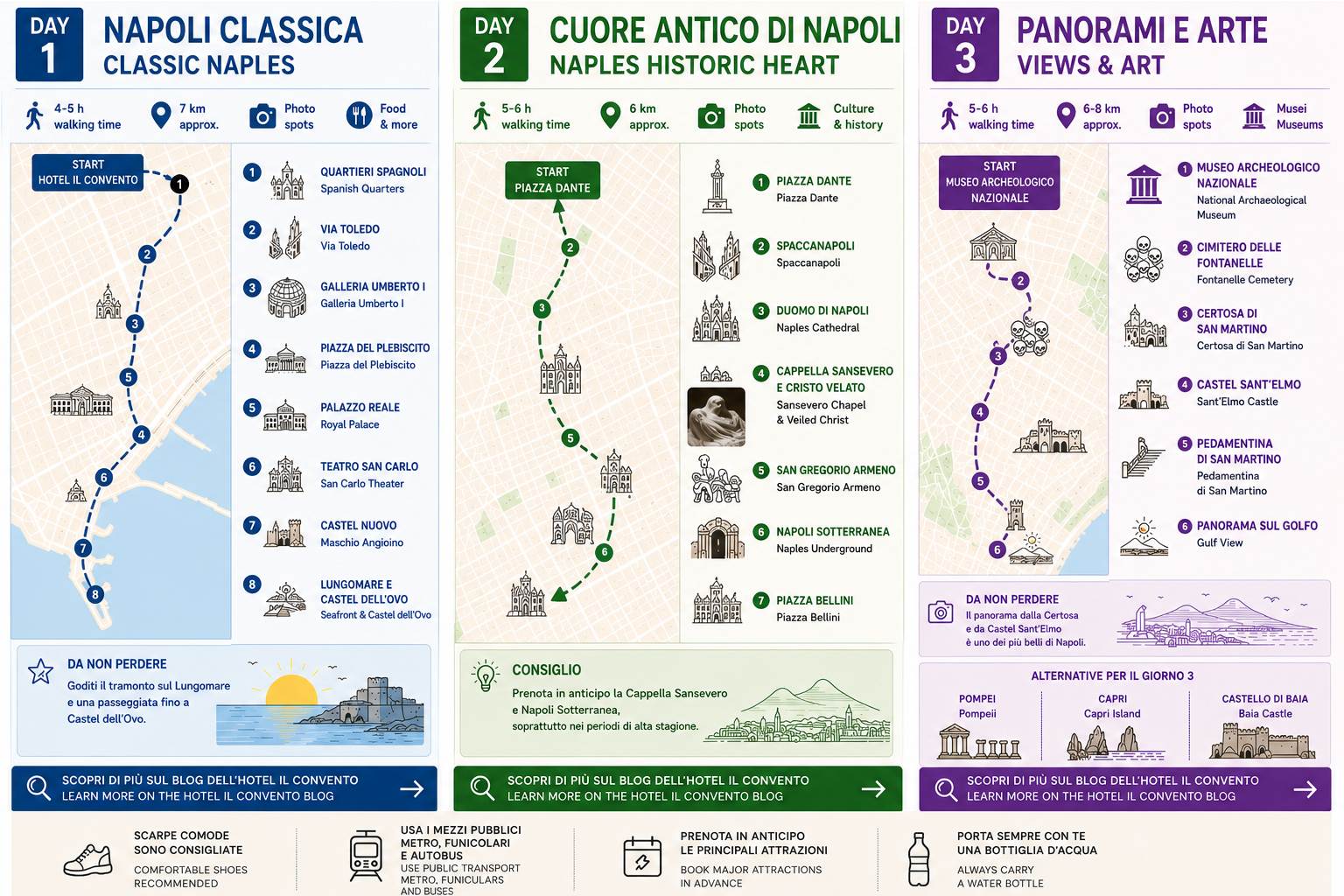
- If possible, combine your walk with a visit to Castel Sant'Elmo and the Certosa di San Martino before starting the descent.
A Suggested Half-Day Itinerary
If you're staying near Via Toledo or the Spanish Quarter, this is one of the most rewarding half-day walks in Naples.
- Take the Central Funicular to Vomero.
- Visit Castel Sant'Elmo.
- Explore the Certosa di San Martino and its panoramic terraces.
- Walk down the Pedamentina to Montesanto.
- Discover the lively Pignasecca Market.
- Return on foot through Via Toledo and the Spanish Quarter.
In just a few hours, you'll experience several completely different sides of Naples—from elegant hilltop viewpoints to vibrant local neighbourhoods.
Frequently Asked Questions
How long does it take to walk the Pedamentina di San Martino?
Most visitors complete the walk in 40 to 60 minutes, although photographers and those who stop frequently to enjoy the views often take longer.
Is the Pedamentina difficult?
The recommended route is almost entirely downhill, making it suitable for most visitors with a reasonable level of mobility. Comfortable footwear is highly recommended because the steps are uneven in places.
Is there an entrance fee?
No. The Pedamentina is a public historic staircase and can be accessed free of charge.
Which is the best direction?
Walking from Vomero down to Montesanto is by far the easiest and most enjoyable option. You'll avoid a demanding uphill climb while enjoying the best panoramic views.
Can I combine the Pedamentina with other attractions?
Absolutely. The walk fits perfectly with visits to Castel Sant'Elmo, the Certosa di San Martino, Pignasecca Market and the Spanish Quarter, creating one of the most varied itineraries in Naples.
Discover Naples One Step at a Time
Some places are designed to be admired from a distance.
The Pedamentina di San Martino invites you to experience Naples at walking pace.
Every flight of steps reveals another layer of the city: medieval walls, hidden gardens, unexpected viewpoints and neighbourhoods where everyday life continues much as it has for generations.
By the time you reach Montesanto, you'll have travelled not only from the hill to the historic centre, but also through centuries of Neapolitan history.
It's a walk that reminds you that the best way to discover Naples isn't always the fastest.
Sometimes, all it takes is one step after another.