RU
RU  ES
ES  FR
FR  EN
EN  IT
IT 

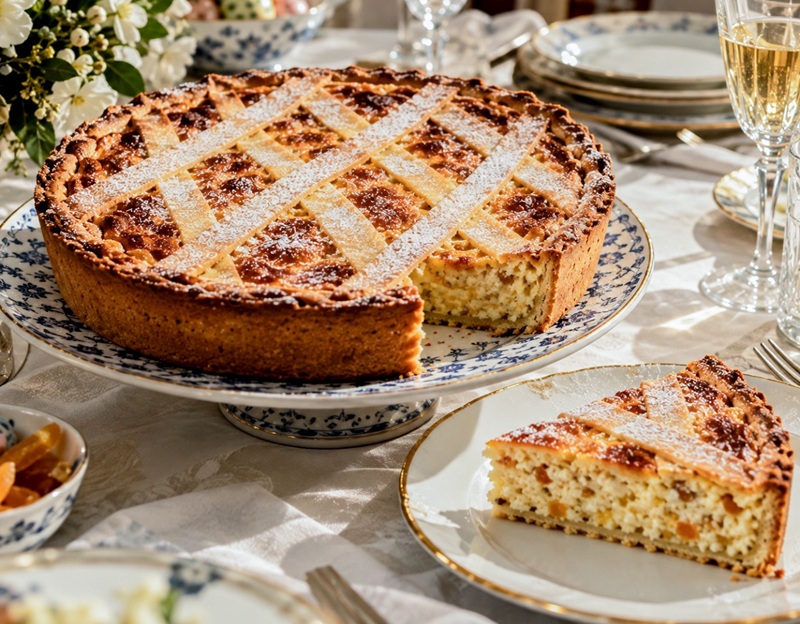
In Naples, the scent of Neapolitan pastiera is one of the unmistakable signs that Easter is approaching. Families prepare shortcrust pastry, mix ricotta with cooked wheat and carefully arrange strips of pastry across the top. Then comes the waiting: according to Neapolitan tradition, pastiera tastes even better after resting for a day or two.
But this traditional Easter cake is much more than a recipe. Its history stretches back centuries, through family kitchens, convents and local legends. And the famous seven pastry strips are said to represent everything from the mythical siren Parthenope to the streets of ancient Naples.
If you are visiting Naples, tasting a slice of pastiera is a delicious way to discover a tradition that remains an important part of the city's identity.
Neapolitan pastiera at a glance
| What is it? | Traditional Neapolitan baked cake with shortcrust pastry, ricotta and cooked wheat |
| When is it eaten? | Especially at Easter, although it can be found throughout the year |
| Main ingredients | Ricotta, cooked wheat, eggs, sugar, candied fruit and orange blossom water |
| The seven strips | A traditional decoration linked to several legends, not a strict rule |
| Where to try it | Traditional pastry shops and historic cafés in Naples |
| Good to know | Every Neapolitan family has its own version of the recipe |
What is Neapolitan pastiera?
Pastiera napoletana is a traditional baked dessert made with a shortcrust pastry shell filled with a soft mixture of ricotta cheese, cooked wheat, eggs and sugar, flavoured with orange blossom water and candied citrus peel.
Strips of pastry are arranged across the surface, creating the distinctive diamond-shaped pattern.
Unlike an ordinary tart, pastiera has a soft, moist filling. The wheat gives it a characteristic texture, while the orange blossom water provides its unmistakable floral fragrance.
It is a dessert closely associated with spring and Easter, but its popularity means that visitors can often enjoy it at other times of the year too.
The history of Neapolitan pastiera
There is no single documented date for the invention of pastiera. The cake developed over centuries, influenced by domestic cooking, convent traditions and recipes that were quite different from the version we know today.
One of the earliest literary references appears in La gatta Cenerentola (The Cat Cinderella), a fairy tale by Giambattista Basile, published in the collection Lo cunto de li cunti between 1634 and 1636.
This shows that pastiera was already known in seventeenth-century Naples, although its ingredients and preparation may have been different.
In 1693, Antonio Latini described a pastiera in his culinary treatise Lo scalco alla moderna. His recipe included savoury ingredients and flavours that would seem unusual in a modern Easter cake.
The pastiera we enjoy today is therefore the result of a long evolution rather than the invention of a single person.
The nuns of San Gregorio Armeno
Neapolitan tradition gives an important role to the nuns of the monastery of San Gregorio Armeno, who were renowned for preparing pastiere for wealthy and aristocratic families.
Convent kitchens are traditionally associated with the refinement of the recipe and its strong connection with Easter.
The ingredients also acquired symbolic meanings: wheat and eggs represented renewal and new life, while orange blossom evoked the arrival of spring.
However, the idea that a particular nun invented pastiera belongs to local tradition rather than established historical fact.
If you are exploring Naples' historic centre, you can also visit San Gregorio Armeno, best known today for its traditional nativity-scene workshops and its long religious history.
What are the ingredients of Neapolitan pastiera?
Every family has its own recipe, and the proportions, aromas and preparation methods may vary. However, a few ingredients define the character of traditional pastiera.
- Shortcrust pastry: forms the base and the decorative strips. Depending on the recipe, it may be made with butter or lard.
- Ricotta cheese: gives the filling its soft texture. Sheep's milk ricotta, cow's milk ricotta or a combination of both may be used.
- Cooked wheat: one of the dessert's defining ingredients. The grains may remain whole or be partially blended.
- Eggs and sugar: provide structure and sweetness.
- Candied citrus peel: usually orange and citron, adding fragrance and texture.
- Orange blossom water: gives pastiera its distinctive aroma. Some recipes also include cinnamon, vanilla or citrus zest.
Some family recipes also include pastry cream. This is a recognised variation, although the characteristic filling of traditional Neapolitan pastiera is based on ricotta and cooked wheat.
This explains why two pastiere can look and taste quite different while still belonging to the same culinary tradition.
Why does Neapolitan pastiera have seven pastry strips?
One of the most fascinating questions about pastiera concerns the seven strips of shortcrust pastry traditionally arranged across its surface: three in one direction and four in the other.
Why seven?
Several explanations have developed over time, drawing on mythology, Naples' ancient street layout and the city's connection with the sea.
The diamond-shaped pastry decoration is a recognised feature of pastiera. However, there is no documented ancient rule requiring exactly seven strips. The number is mainly associated with popular traditions and legends.
The legend of Parthenope and the seven gifts
According to one of the best-known legends, the siren Parthenope lived in the Bay of Naples and enchanted its inhabitants with her beautiful singing.
To thank her, the people offered seven gifts, each with a symbolic meaning:
- Flour: representing wealth.
- Ricotta: a gift from the shepherds, symbolising abundance.
- Eggs: representing new life and renewal.
- Wheat cooked in milk: symbolising the meeting of the plant and animal worlds.
- Orange blossom water: representing the fragrances of the land.
- Spices: recalling distant peoples, cultural exchange and hospitality.
- Sugar: symbolising the sweetness of the siren's song.
Parthenope took the gifts to the gods, who combined them to create the first pastiera. In other versions of the story, the siren herself prepared the cake.
The seven pastry strips are therefore interpreted as a tribute to the seven gifts, linking pastiera to Naples' mythical origins, the sea and springtime.
Do the seven strips represent the streets of ancient Naples?
Another popular interpretation connects the pastry decoration to the layout of ancient Greek and Roman Naples.
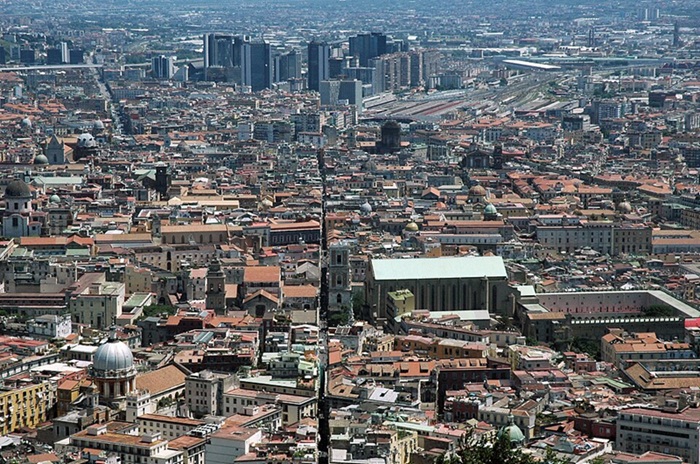
According to this story, the three strips in one direction represent the city's three ancient east–west streets, known as decumani, while the four crossing strips represent the north–south streets, often called cardini.
It is a charming image, but not a historically accurate map: ancient Naples had more than four crossing streets.
The connection is best understood as a symbolic representation rather than a proven explanation of the decoration.
To discover the real streets of the ancient centre, read our guide to Spaccanapoli and what to see along its historic route.
The legend of the fishermen's seven baskets
A third legend tells of women who placed seven baskets of ingredients on the beach, asking the sea to bring their fisherman husbands safely home.
During the night, the waves mixed the offerings together. By morning, the women discovered a pastiera.
In this version, the seven strips represent the baskets entrusted to the sea.
Like many traditional stories, the legend exists in several variations. Its importance lies in the connection it creates between the dessert, the people of Naples and the sea.
Pastiera and Easter traditions in Naples
Preparing pastiera is traditionally part of Holy Week in Neapolitan homes.
Many families make it on Maundy Thursday or Good Friday, allowing the cake to rest before Easter Sunday lunch.
Resting is an important part of the preparation. It allows the filling to settle and the different flavours to develop and blend.
The round baking tin used for pastiera is called a ruoto in Naples. The cake is often kept or given as a gift in its tin, which also helps protect the delicate pastry during transport.
For many Neapolitans, making pastiera is a family ritual passed down through generations. Every household has its own preferred ingredients, proportions and little secrets.
Although it remains Naples' quintessential Easter dessert, pastiera is also available in many pastry shops outside the Easter season.
Where to eat Neapolitan pastiera in Naples
If you are visiting Naples, trying a slice of pastiera is one of the simplest and most enjoyable ways to experience the city's culinary heritage.
Near Via Toledo and Piazza del Plebiscito, there are two very different places worth considering.
Gran Caffè Gambrinus: a taste of Neapolitan tradition
Gran Caffè Gambrinus, near Piazza del Plebiscito, is one of Naples' most famous historic cafés.
It is a particularly appealing choice if you would like to enjoy pastiera in a setting closely connected with the city's history, perhaps accompanied by a traditional Neapolitan espresso.
Gambrinus offers pastiera among its pastry specialities, alongside other classic Neapolitan desserts.
Luminist: a contemporary atmosphere
For a more modern and elegant setting, consider Luminist, located inside the Gallerie d'Italia on Via Toledo.
Its atmosphere is very different from that of a traditional Neapolitan café, with refined interiors and a contemporary food and drink offering.
It can be an interesting place to take a break while exploring the monumental centre. If you specifically want to try pastiera, check whether it is available on the day's menu. Luminist should not be considered a traditional takeaway pastry shop.
When ordering pastiera, you can also ask which type of ricotta is used and whether the wheat is left whole or blended. These details help explain the differences between recipes.
Can you bring Neapolitan pastiera home?
Pastiera can make a lovely edible souvenir from Naples.
If you are planning to travel with one, ask the pastry shop for suitable packaging and specific storage instructions. Shelf life and storage conditions depend on the recipe and preparation.
Visitors with allergies or food intolerances should remember that traditional pastiera normally contains wheat and gluten, milk products and eggs. Always check the ingredients with the pastry shop before buying.
FAQ about Neapolitan pastiera
What is Neapolitan pastiera made of?
The main ingredients are shortcrust pastry, ricotta cheese, cooked wheat, eggs, sugar, candied citrus peel and flavourings, especially orange blossom water.
Why does pastiera have seven strips?
Popular legends connect the seven strips to the gifts offered to the siren Parthenope, the streets of ancient Naples or seven baskets left by fishermen's wives. However, there is no documented ancient rule requiring exactly seven strips.
Does traditional pastiera always have seven strips?
No. The diamond-shaped decoration is traditional, but a pastiera does not lose its identity simply because it has a different number of pastry strips.
Is pastiera only eaten at Easter?
No. Pastiera is Naples' traditional Easter cake, but it can also be found in pastry shops throughout the year.
Does traditional pastiera contain pastry cream?
The characteristic filling is made with ricotta and cooked wheat. Pastry cream appears in some family variations but is not an essential ingredient.
Why is pastiera prepared before Easter Sunday?
Making it in advance allows the filling to settle and the aromas to blend, which is why many families prepare it on Maundy Thursday or Good Friday.
Tips from Hotel Il Convento
If you are staying at Hotel Il Convento, in the heart of the Spanish Quarter, we recommend taking a walk along Via Toledo and stopping for a slice of pastiera.
For a classic Neapolitan experience, choose Gran Caffè Gambrinus, just a few steps from Piazza del Plebiscito. It is a wonderful place to enjoy this traditional cake with an espresso in one of Naples' historic cafés.
If you prefer a contemporary setting, Luminist at the Gallerie d'Italia offers an elegant alternative, although we recommend checking whether pastiera is available before your visit.
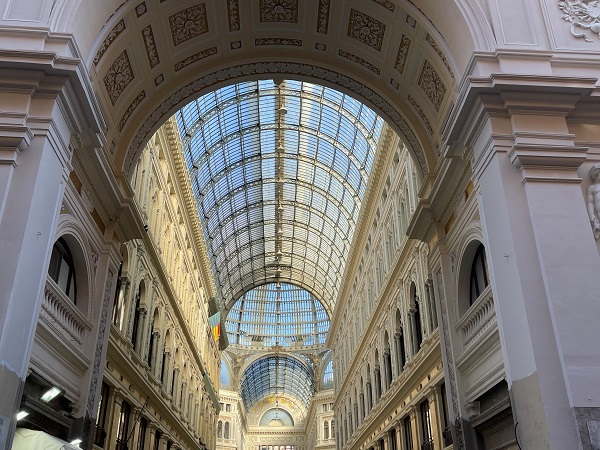
You can easily include this sweet stop in our Naples in 2 Days itinerary, during the walk between Via Toledo, Galleria Umberto I and Piazza del Plebiscito.
And one final tip from Naples: don't expect every pastiera to taste exactly the same. The variations in family recipes, the delicate orange blossom fragrance and the texture of the filling are all part of what makes this traditional dessert so special.