RU
RU  ES
ES  FR
FR  EN
EN  IT
IT 

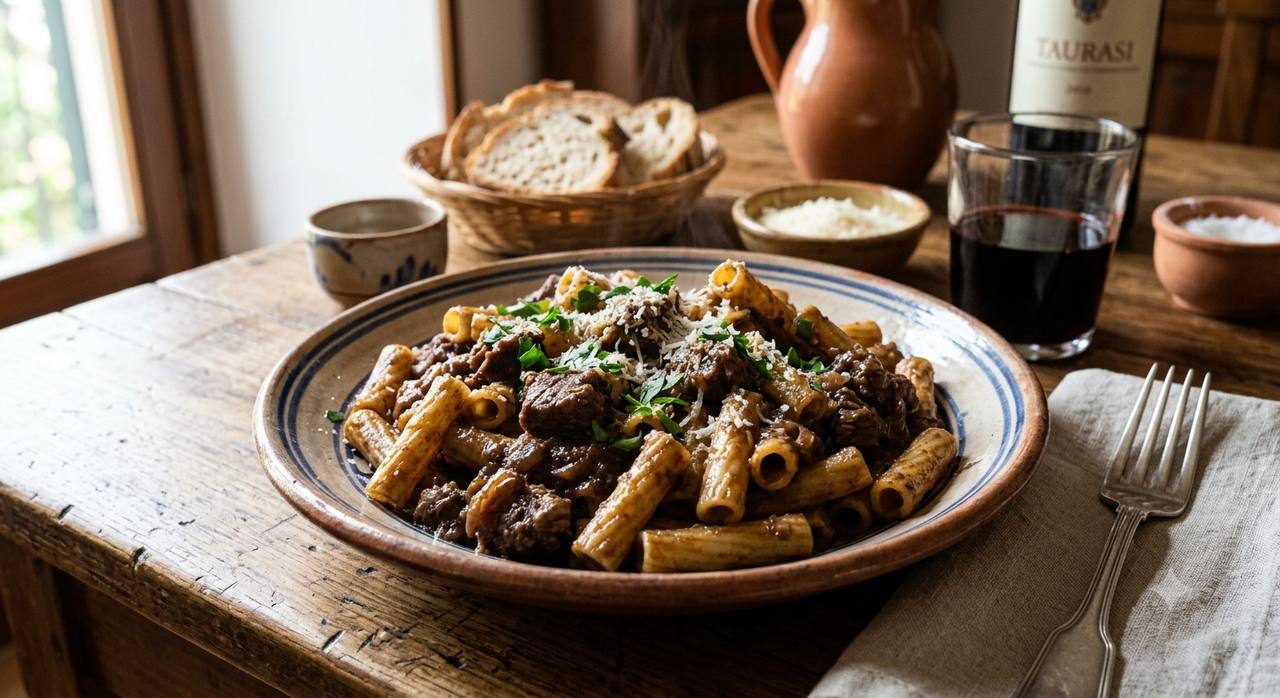
If Neapolitan pizza represents the most famous side of Naples' food culture, Genovese reveals something more intimate.
This is not a dish that can be prepared in a hurry. It takes time, patience and hours of slow cooking, during which onions gradually melt into a rich, velvety sauce that coats the meat and pasta with an unmistakable flavour.
For anyone visiting Naples, Genovese is one of those dishes worth trying at least once. It offers a glimpse into a different side of Neapolitan cuisine: the food of family kitchens, recipes passed down through generations and long Sunday lunches.
What is Neapolitan Genovese?
Despite what its name might suggest, Genovese is a traditional Neapolitan dish, not a speciality from Genoa.
The sauce is traditionally prepared with:
- large quantities of onions;
- beef, usually a cut suitable for long, slow cooking;
- celery and carrots;
- white wine;
- a very slow cooking process that can take six or seven hours.
The result is much more than a simple pasta sauce. During the long cooking process, the onions gradually break down and transform into a naturally creamy sauce with a deep, distinctive flavour.
Traditionally, Genovese is served with ziti broken by hand, although today you will also find restaurants serving it with broken candele pasta, paccheri or rigatoni.
Why is it called Genovese if it comes from Naples?
This is one of the most common questions about the dish and, at the same time, one of the great mysteries of Neapolitan food history.
There is no definitive answer. Over the centuries, several theories have tried to explain why one of Naples' most traditional recipes bears a name that seems to point towards Genoa.
The theory of the Genoese cooks
According to one of the most widespread theories, cooks from Genoa were working in taverns around the port of Naples several centuries ago.
Dishes based on meat and onions may gradually have been adapted to local tastes, eventually contributing to the recipe that Neapolitans know today as Genovese.
A recipe that became entirely Neapolitan
Another theory suggests that the dish was actually created in Naples and simply took its name from the person who prepared it or perhaps from an old tavern frequented by Genoese merchants.
Its exact origins are still debated. Whatever the truth may be, one thing is certain: today Genovese belongs completely to the culinary tradition of Naples.
The secret of Genovese? Time
In a world dominated by speed, Genovese represents exactly the opposite.
There are no shortcuts.
The onions should not be fried. They need to cook very slowly, gradually softening until they almost melt away. Over several hours, they release their natural sugars and become the rich, creamy sauce that gives Genovese its distinctive character.
It is precisely this slow transformation that makes the dish so special.
A dish rooted in family tradition
For many Neapolitans, Genovese tastes of memories.
It is the aroma that used to fill the house on a Sunday morning, when the sauce was put on the stove early and left to cook slowly for hours.
Every family has its own version.
Some add a small amount of tomato paste, others swear by a particular variety of onion. Different cuts of meat are used from one household to another, and many families have their own little secrets that will never appear in a cookbook.
It is one of those dishes that can tell you more about the identity of a city than many travel guides ever could.
Is there a vegan version of Genovese?
In recent years, some chefs have reinterpreted this traditional recipe without using meat, while preserving the long, slow cooking of the onions that forms the true heart of the dish.
The result can be surprisingly rich and shows how Neapolitan cuisine can evolve without losing its connection with tradition.
Vegetarian and vegan travellers can therefore discover a different interpretation of one of the great classics of Neapolitan food culture.
Where to eat Genovese in Naples
There are many restaurants and traditional trattorias in Naples where you can try Genovese. Here are some places in different parts of the city, from traditional versions to completely plant-based alternatives.
In the Spanish Quarters, a few minutes from Hotel Il Convento
Addò Sapurit
Just a few minutes' walk from Hotel Il Convento, Addò Sapurit is located on Via Speranzella, in the heart of the Spanish Quarters.
It is a convenient choice if you want to try traditional Neapolitan dishes without leaving the neighbourhood. The menu includes Genovese with meat, alongside other local classics such as pasta and potatoes with provola cheese and scarpariello.
It is therefore an easy place to discover Genovese while experiencing one of the most characteristic neighbourhoods in Naples.
Near the Pignasecca area
Biancomangiare
Biancomangiare is located in Vico San Nicola alla Carità, not far from Pignasecca, and specialises in traditional Neapolitan cuisine.
Its location makes it easy to combine lunch or dinner with a walk around Pignasecca, an area where everyday Neapolitan life is still very much visible among market stalls, small shops and neighbourhood businesses.
The restaurant's more refined atmosphere also creates an interesting contrast with the lively streets outside, making it an enjoyable stop while exploring central Naples.
In the Chiaia district
Ostaria Pignatelli
If you would like to explore the Chiaia district, Ostaria Pignatelli, on Riviera di Chiaia, offers a cuisine that celebrates historic Neapolitan recipes with particular attention to the quality of its ingredients.
Among its characteristic dishes are candele pasta with Genovese, a preparation that perfectly reflects the restaurant's connection with traditional Neapolitan cuisine.
Ostaria Pignatelli is farther from Hotel Il Convento than the previous restaurants, but Chiaia is easily reached by public transport. You can find information about lines, tickets and stations in our Naples Metro Guide.
Where to eat vegan Genovese in Naples
Not eating meat does not necessarily mean missing out on the flavours associated with Genovese. A few restaurants in Naples specialising in plant-based cuisine have created their own versions of this traditional dish.
Vitto Pitagorico
Located near the National Archaeological Museum, Vitto Pitagorico is one of Naples' best-known restaurants dedicated to plant-based cuisine.
Its menu includes Bella Napoli – La Genovese, made with hand-broken candele pasta, an onion ragù and soya, offering a completely plant-based interpretation of the traditional recipe.
It is an interesting option for vegan and vegetarian travellers who would like to discover the flavours of Neapolitan cuisine from a different perspective.
Core Napoletano 100% Vegetale
In the Bagnoli area, Core Napoletano 100% Vegetale focuses entirely on plant-based Neapolitan food, reinterpreting some of the city's traditional flavours without animal ingredients.
It is quite different from a traditional sit-down trattoria and also focuses on food delivery. Although Bagnoli is some distance from Hotel Il Convento, it can therefore be an interesting alternative for travellers looking for plant-based Neapolitan food without necessarily travelling across the city.
A dish that tells the story of Naples
Genovese is much more than a pasta dish.
It tells the story of a city that has always made cultural influences part of its identity. A recipe probably born from the meeting of different traditions, over the centuries it has become one of the most authentic symbols of Neapolitan cuisine.
Many travellers arrive in Naples thinking first about pizza, but leave remembering other flavours too — including the unmistakable aroma of a Genovese that has been slowly cooking for hours.
And this is perhaps one of the most fascinating things about Neapolitan cuisine. Alongside the famous dishes known throughout the world, Naples continues to preserve recipes that have been part of family life for generations and deserve to be discovered with the same curiosity you would bring to a castle, a museum or a street in the historic centre.
And after Genovese? There is always room for something sweet. Continue your journey through Neapolitan food traditions with our guide to where to eat the best sfogliatella in Naples and discover the difference between the traditional riccia and frolla.
Frequently asked questions about Neapolitan Genovese
Is Genovese from Naples or Genoa?
Despite its name, Genovese is considered one of the most representative dishes of traditional Neapolitan cuisine. Its exact origins are still debated, and several theories have been proposed over the centuries to explain its curious connection with Genoa.
What pasta is traditionally served with Genovese?
The traditional choice is ziti broken by hand. Today, however, many restaurants also serve Genovese with broken candele pasta, rigatoni or paccheri.
How long does Genovese take to cook?
Traditional Genovese requires several hours of very slow cooking. The onions need enough time to soften and gradually break down until they form the rich, creamy sauce that characterises the dish.
Does Genovese contain tomatoes?
Traditional Genovese is generally considered a white sauce, with onions as its main ingredient. However, as with many Neapolitan family recipes, variations exist and some cooks add a small amount of tomato paste.
Is there a vegetarian or vegan Genovese?
Yes. In recent years, some restaurants have reinterpreted Genovese without meat, focusing instead on the long cooking of the onions and using plant-based ingredients. It is not the traditional recipe, of course, but it allows vegetarian and vegan travellers to discover a different interpretation of the flavours associated with this Neapolitan classic.
Where can I eat Genovese near the Spanish Quarters?
In the Spanish Quarters, Addò Sapurit on Via Speranzella is one of the most convenient options for guests staying at Hotel Il Convento. It is only a few minutes' walk from the hotel and serves Genovese among its Neapolitan dishes.
Is Genovese worth trying in Naples?
Absolutely, especially if you want to discover Neapolitan cuisine beyond its most internationally famous dishes. Genovese belongs to the city's home-cooking tradition and is one of the recipes that best represents the slow, patient cooking associated with traditional Neapolitan Sunday lunches.