DE
 ES
 FR
 EN
 IT


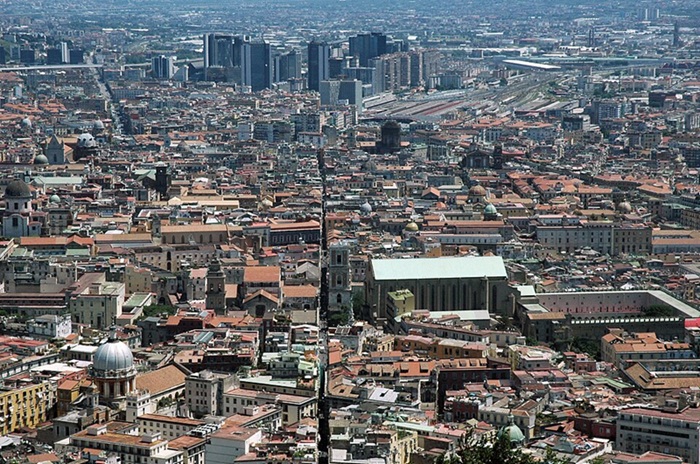
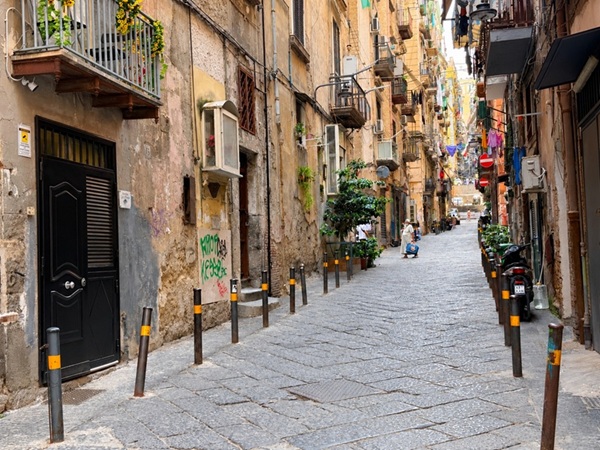
Spaccanapoli is not a neighbourhood, nor is it the official name of a single street. It is the popular name given to the long route that crosses Naples' historic centre and, when seen from above, appears to cut straight through the ancient city.
The route changes name several times as it crosses the centre: Via Pasquale Scura, Via Maddaloni, Via Benedetto Croce, Via San Biagio dei Librai and Via Vicaria Vecchia. Its origins are extremely ancient and are connected with the urban layout of Naples in the Greek and Roman periods and with what is traditionally known as the lower decumanus.
Walking along Spaccanapoli today means travelling through a fundamental part of Naples' history, passing monumental squares, churches, historic palaces, workshops, narrow side streets and some of the best-known sights in the ancient city.
Spaccanapoli at a glance
| What is it? | A historic route through ancient Naples, not a neighbourhood |
| Main streets | Via Pasquale Scura, Via Maddaloni, Via Benedetto Croce, Via San Biagio dei Librai and Via Vicaria Vecchia |
| Where to start | Piazza del Gesù Nuovo is the most convenient starting point for visitors |
| Minimum time | Around 2 hours |
| Recommended time | Half a day if you want to visit churches and monuments |
| How to explore it | On foot |
| Metro | Dante or Toledo, Line 1 |
| Cost | Walking along Spaccanapoli is free; some attractions require tickets |
| What to eat | Pizza a portafoglio, fried pizza, cuoppo, sfogliatella and babà |
Why is it called Spaccanapoli?
The name comes from the visual effect created by this long route as it crosses the dense fabric of Naples' historic centre. This is particularly easy to understand when looking at the city from above, for example from the San Martino area: Spaccanapoli appears as an almost straight line that seems to split Naples in two.
Its origins go back to the ancient Greek and Roman street plan. Spaccanapoli is generally associated with the lower decumanus, one of the major east-west axes of the ancient city of Neapolis.
It should not be confused with the major decumanus, largely corresponding to today's Via dei Tribunali, or with the upper decumanus further north. The lower, major and upper decumani formed part of the ancient street system and still help us understand the structure of Naples' historic centre today.
What to see along Spaccanapoli: walking itinerary
For a first visit, we recommend starting from Piazza del Gesù Nuovo and continuing east. There is no need to follow the route without ever leaving it: some of the most interesting places are found just a few metres away in the surrounding streets and alleys.
Piazza del Gesù Nuovo
Piazza del Gesù Nuovo is one of the best places to begin a walk along Spaccanapoli.
Here you will find the Church of Gesù Nuovo, immediately recognisable by its unusual diamond-point façade, and the monumental complex of Santa Chiara.
If you are arriving by metro, use Line 1. The most convenient stations are Dante and Toledo; Piazza del Gesù Nuovo is a short walk from either station.
Santa Chiara
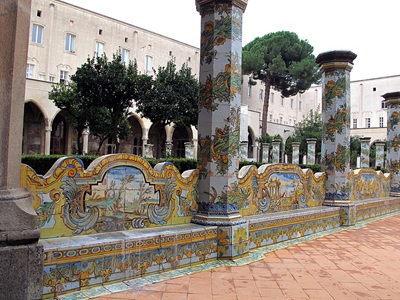
Majolica Cloister of Santa Chiara – Photo: Sailko / Wikimedia Commons – CC BY 3.0
The Santa Chiara complex is one of the most important stops along the route. The Church of Santa Chiara and its famous Majolica Cloister are well worth a detour if you have enough time.
The basilica was built in the 14th century for Robert of Anjou (Robert the Wise) and Queen Sancha of Majorca and is one of the city's great religious complexes.
If you plan to visit the cloister and museum areas as well, allow more time than you would for a simple walk along Spaccanapoli.
Discover Naples, Stay in Its Heart
At Hotel Il Convento, in the heart of Naples' Spanish Quarter, you're just a short walk from Via Toledo and the city's main attractions. Book directly with us and discover our exclusive rates.
BOOK YOUR STAYVia Benedetto Croce
From Piazza del Gesù, the route continues along Via Benedetto Croce, one of the streets that make up Spaccanapoli.
This is one of the most enjoyable sections of the walk, lined with historic buildings, churches, bookshops, small stores and places to eat as you make your way towards Piazza San Domenico Maggiore.
Piazza San Domenico Maggiore
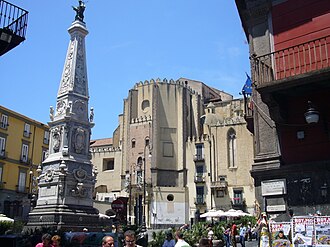
Continue along Via Benedetto Croce and you will reach Piazza San Domenico Maggiore, one of the most atmospheric squares in Naples' historic centre.
The square is dominated by the Obelisk of San Domenico and the Basilica of San Domenico Maggiore, one of the most important religious and historic sites in ancient Naples.
Sansevero Chapel and the Veiled Christ

Veiled Christ, Sansevero Chapel – Wikimedia Commons
A few minutes from Piazza San Domenico Maggiore is the Sansevero Chapel, best known for Giuseppe Sanmartino's extraordinary Veiled Christ.
The chapel is not directly on the main Spaccanapoli route, but the detour is very short. If you want to visit, check current booking and admission arrangements before your trip.
Piazzetta Nilo and the Corpo di Napoli
Returning towards Spaccanapoli, you reach Piazzetta Nilo, home to the ancient statue of the Nile god, traditionally known as the Corpo di Napoli – the “Body of Naples”.
It is one of the most unusual reminders of the communities that lived in this part of Naples in ancient times and of the many historical layers that still characterise the area.
Via San Biagio dei Librai
From here, Spaccanapoli continues along Via San Biagio dei Librai, one of the liveliest sections of the route.
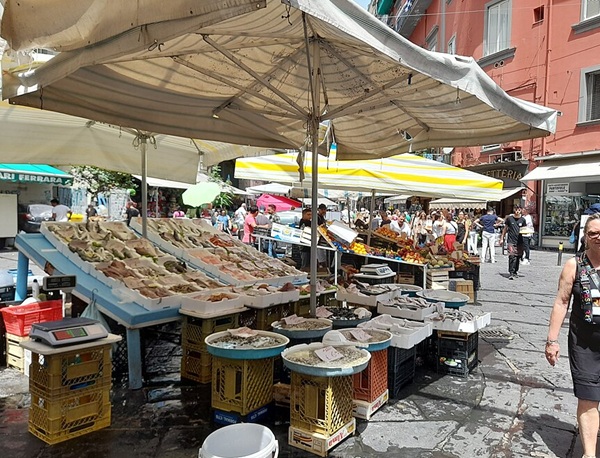
The street is narrow and busy, filled with workshops, churches, historic buildings and small shops. It is one of the places where the contrast – and coexistence – between monumental Naples and everyday city life is most apparent.
The Doll Hospital
Along Via San Biagio dei Librai you will also find the historic Ospedale delle Bambole, or Doll Hospital. It grew out of the traditional craft of repairing dolls and today remains one of the most unusual places to discover in Naples' historic centre.
San Gregorio Armeno
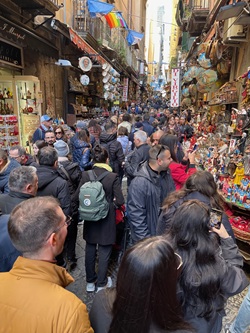
A little further along you reach San Gregorio Armeno, Naples' famous street of nativity-scene workshops.
It is an almost unavoidable detour when walking along Spaccanapoli. The workshops can be visited throughout the year, although the street becomes particularly busy in the run-up to Christmas.
Towards Via Duomo and Forcella
Continuing east, the route passes through an increasingly popular and lived-in part of the ancient centre before reaching Via Duomo.
From here, you can make a short detour to visit Naples Cathedral and San Gennaro.
Beyond Via Duomo, the historic axis continues towards Via Vicaria Vecchia and the Forcella neighbourhood, where Spaccanapoli enters another densely built and deeply historic part of the city.
Some reconstructions of the historic route also include streets in the eastern part of the centre, including the area around Via Ottavio Tupputi. For most visitors, however, the section between Piazza del Gesù, Via Benedetto Croce, Via San Biagio dei Librai, Via Duomo and Forcella is the easiest and most rewarding part to follow.
What to eat along Spaccanapoli
Spaccanapoli is also one of the best routes for discovering Neapolitan street food.
During your walk, stop for a pizza a portafoglio, fried pizza or a cuoppo of fried specialities, and perhaps finish with a sfogliatella or babà.
For more ideas, see our guide to Neapolitan fried food.
Where to eat around Spaccanapoli: a few places we recommend
There are countless places to eat around Spaccanapoli and the nearby streets. Rather than trying to rank the “best” restaurants in Naples, here are a few useful addresses to keep in mind while exploring the historic centre.
For pizza: Via dei Tribunali is home to several historic pizzerias where you can try a classic Neapolitan pizza. One of the best-known names is Sorbillo, a good choice if you want to sit down and enjoy a traditional Margherita or Marinara.
For fried pizza: in Piazzetta Nilo, you can stop at Zia Esterina Sorbillo. Its location makes it particularly convenient while walking along Spaccanapoli.
For Neapolitan fried food: on Via San Biagio dei Librai, Friggitoria Napoletana da Rosetta is a good option for a quick stop and a taste of frittatine, crocchè and other classics of Neapolitan street food.
For traditional Neapolitan cooking: near Piazzetta Nilo, Antica Trattoria del Nilo is an alternative to pizza if you would rather sit down and try some of the city's traditional dishes.
For pasta and potatoes: the historic centre is also a great place to discover one of Naples' most beloved traditional dishes, often prepared with mixed pasta and smoked provola cheese. One place to consider is La Locanda Gesù Vecchio, just a short walk from Spaccanapoli. To learn more about this comforting speciality and discover other traditional restaurants, read our guide to pasta and potatoes in Naples: 5 places to try.
For something sweet: when you reach Piazza San Domenico Maggiore, you can stop at Scaturchio, a historic Neapolitan pastry shop where you can try sfogliatella, babà and other local pastries.
For something sweet, look out for Neapolitan pastiera, a traditional cake made with ricotta, cooked wheat and orange blossom water. Although closely associated with Easter, it can also be enjoyed at other times of the year.
For something different: if you are looking for a lively Neapolitan atmosphere but a more international menu, we also like Posca, on Via Port'Alba. This bar, bakery and bistro is a good option at different times of the day, from breakfast and brunch to aperitivo and after-dinner drinks. It is not a traditional Neapolitan restaurant, and that is precisely why it can be a welcome alternative after a few days of pizza and local specialities.
Hotel Il Convento's tip
Don't feel that you always have to choose the most famous place. In Naples' historic centre, sometimes the best way to enjoy the food is simply to follow the rhythm of the day: a pizza a portafoglio or a frittatina while you walk, a sfogliatella in the afternoon, and a pizzeria or trattoria when you have time to sit down and relax. And if you feel like a change from traditional Neapolitan food, somewhere like Posca can be a pleasant alternative.
How long do you need for Spaccanapoli?
Allow at least two hours to walk along Spaccanapoli and see its main sights.
If you want to enter churches, visit Santa Chiara, the Sansevero Chapel or Naples Cathedral and stop for something to eat, half a day is much more realistic.
The best thing about Spaccanapoli is not being in too much of a hurry. The route itself is relatively straightforward, but the side streets, courtyards and squares are what make the walk particularly interesting.
When is the best time to visit Spaccanapoli?
You can walk along Spaccanapoli at any time of day, but morning and early afternoon are generally best if you also want to visit churches, museums and monuments.
In the evening, many parts of the route remain lively thanks to restaurants, pizzerias and bars, although cultural attractions will naturally be closed.
How to reach Spaccanapoli from Hotel Il Convento
From Hotel Il Convento, reaching Spaccanapoli is very easy and there is no need to use public transport.
The hotel is located in the Spanish Quarter, just a few steps from Via Toledo. Cross Via Toledo and walk towards Piazza del Gesù Nuovo, where you can join the section of Spaccanapoli that continues along Via Benedetto Croce.
It is worth clarifying that Spaccanapoli and the Spanish Quarter are not the same area. The Spanish Quarter is a historic neighbourhood that developed mainly in the 16th century on the western side of Via Toledo. Spaccanapoli, by contrast, is an ancient urban axis whose origins are connected with the Greek and Roman layout of the city and the historic centre of ancient Naples.
This means that when walking from the Spanish Quarter, simply crossing Via Toledo takes you in just a few minutes from a neighbourhood largely shaped in the early modern period to one of the principal routes of the ancient city.
To discover more about the area around the hotel, read our guide to the Spanish Quarter in Naples.
Spaccanapoli during a weekend in Naples
If you only have a weekend in Naples, Spaccanapoli is one of the walks we would definitely include.
Its central location makes it easy to combine with San Gregorio Armeno, Naples Cathedral and other attractions in the historic centre without wasting time travelling across the city.
See how to include it in your stay in our Naples in 2 Days itinerary.
FAQ about Spaccanapoli
Is Spaccanapoli a street or a neighbourhood?
Spaccanapoli is neither a neighbourhood nor the official name of one single street. It is the popular name for a long route through Naples' historic centre made up of several streets whose names change along the way. The main sections include Via Pasquale Scura, Via Maddaloni, Via Benedetto Croce, Via San Biagio dei Librai and Via Vicaria Vecchia.
Where does Spaccanapoli start?
That depends on what you mean by Spaccanapoli. The complete historic axis runs through several streets and can also be followed from the area around Via Pasquale Scura and Via Maddaloni. For visitors, however, Piazza del Gesù Nuovo is one of the easiest and most recognisable starting points. From here, continue along Via Benedetto Croce, Piazza San Domenico Maggiore and Via San Biagio dei Librai towards Via Duomo and Forcella.
Is Spaccanapoli close to the Spanish Quarter?
Yes. Spaccanapoli and the Spanish Quarter are very close to one another, but they are not the same area. Via Toledo is a useful reference point between them: from the Spanish Quarter, you can cross Via Toledo and reach Piazza del Gesù Nuovo and the most visited section of Spaccanapoli in just a few minutes on foot.
Are Spaccanapoli and Via dei Tribunali the same street?
No. Spaccanapoli mainly follows the route traditionally associated with the lower decumanus, while Via dei Tribunali largely corresponds to the major decumanus. They are two different ancient axes running roughly parallel through parts of Naples' historic centre.
How long does it take to visit Spaccanapoli?
Allow around two hours for a walk covering the main stops. If you also want to visit Santa Chiara, the Sansevero Chapel, churches and other monuments, allow at least half a day.
Is Spaccanapoli free to visit?
Yes. Walking along Spaccanapoli is completely free. Some churches, museums and attractions along or near the route charge an admission fee.
Hotel Il Convento's tip
Follow the main Spaccanapoli route, but don't be afraid to wander away from it. Step into the squares, look through open courtyards, explore a side street and stop whenever something catches your attention.
Alternating famous monuments with small, unplanned detours is one of the best ways to understand this part of Naples.
If you are starting from Hotel Il Convento, walk to Piazza del Gesù Nuovo and begin from there towards Via Benedetto Croce and Via San Biagio dei Librai. There is no need to plan every stop in advance: leave some room for curiosity.
Discover Naples, Stay in Its Heart
At Hotel Il Convento, in the heart of Naples' Spanish Quarter, you're just a short walk from Via Toledo and the city's main attractions. Book directly with us and discover our exclusive rates.
BOOK YOUR STAY